Call now Book

Microneedling · From $249

04 / 07

Microneedling in Huntington Beach

Stimulate collagen. Improve texture, scars, and tone.

  • Time 60 min
  • Downtime 24–48h redness (looks like a mild sunburn)
  • Pain Numbing applied; mild prickle sensation
  • Results Typically begin around week 2; full effect around week 6; cumulative across sessions
  • Sessions 3–6 sessions, spaced 4 weeks apart

The Menu

Microneedling
pricing.

All prices listed are starting prices. Membership benefits apply to toxin + skincare retail — see memberships.

Add-on boosters

What to expect

Honest, considered.

  1. 01

    Cleanse + numb

    Topical numbing for 20 minutes before treatment.

  2. 02

    Microneedling pass

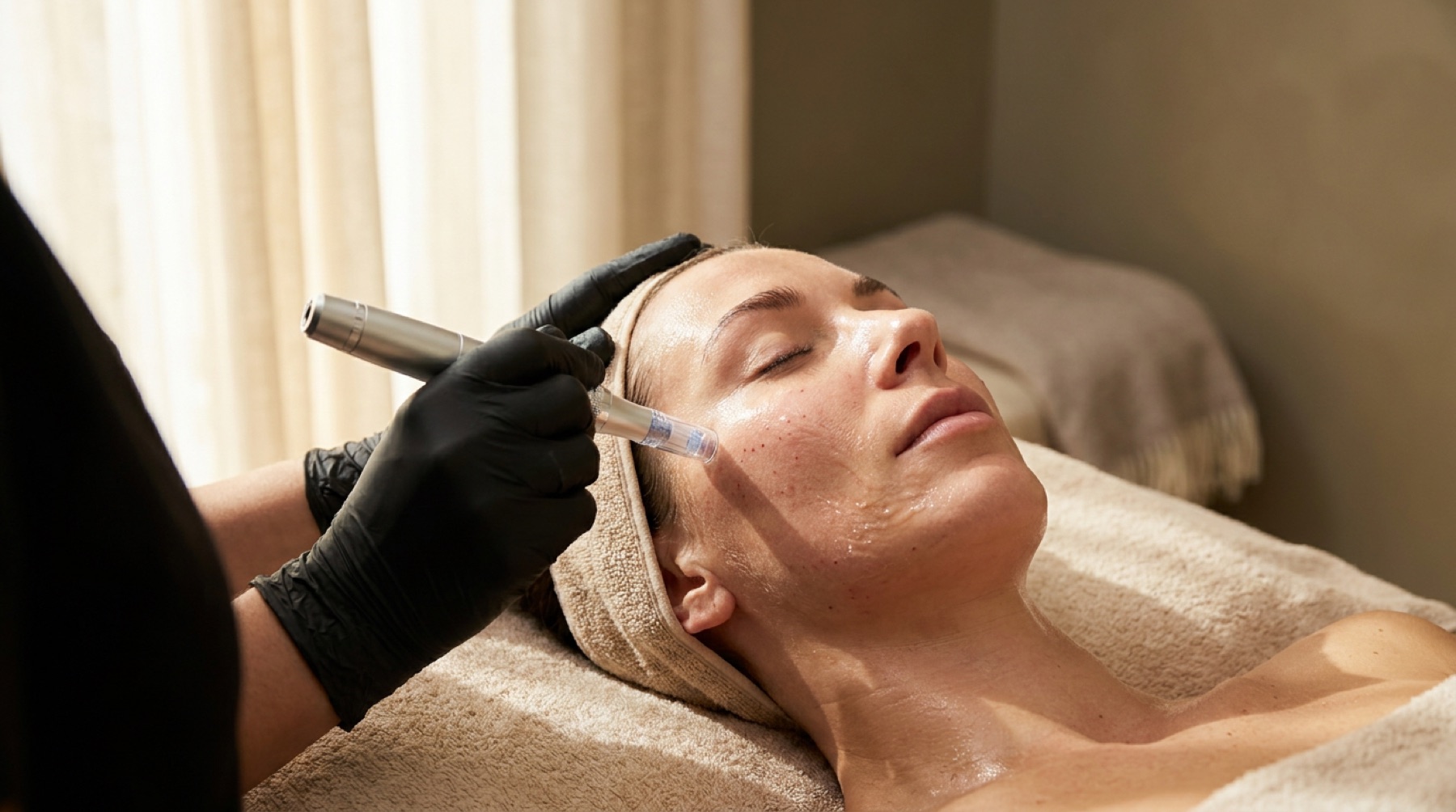
    Adjustable-depth pen makes thousands of micro-channels to trigger collagen rebuild.

  3. 03

    Booster application

    Optional PRP/PRF from your own blood, or exosomes. Pushed into the open channels.

  4. 04

    Calm + protect

    Cooling mask + recovery serum. Strict SPF for 5 days post — non-negotiable for the result to hold.

Honest screening

Who's a good fit,
and who should wait.

Conservative defaults. If anything below applies to you, we'll talk it through at consult — not every "wait" is permanent, and many are short-term. The visit itself is the real screen.

Good candidate

  • Texture concerns — fine lines, enlarged pores, rolling or boxcar acne scars
  • General skin-quality plan — building collagen across multiple sessions (typically 3–6)
  • Comfortable with 24–48 hours of pink, sunburn-like redness post-treatment
  • Willing to commit to strict SPF and gentle aftercare for 5–7 days

Pause / consult first

  • Currently pregnant or breastfeeding
  • Active acne breakout, eczema flare, or rosacea flare on the treatment area
  • Active cold sore or open skin lesion
  • On isotretinoin (Accutane) within the past 6 months
  • Bleeding or clotting disorder, or on anticoagulants without MD clearance
  • History of keloid or hypertrophic scarring

A texture protocol, not a one-off facial.

Microneedling is collagen work. An adjustable-depth pen opens thousands of tiny vertical channels in the skin, the body reads those channels as injury, and the healing response lays down fresh collagen and elastin in the months that follow. That is the entire mechanism. There is no magic, no light show, just a controlled micro-injury that triggers the skin to rebuild itself slightly denser and slightly more even each time.

The thing patients most often misunderstand about microneedling is that it is a multi-session protocol, not a single treatment. One session is a refresh. Three sessions, spaced four weeks apart, is where the visible change starts to compound. Five to six sessions is where serious scar work and serious texture work happens. Anyone selling it as a single, one-and-done treatment is selling the wrong story.

We use it most for acne scarring (rolling and boxcar, especially), enlarged pores, fine lines, sun-related texture, and the general unevenness that gets harder to dismiss after thirty-five. It is not a treatment for active acne, and it is not a substitute for laser resurfacing on deeper scarring. We will tell you the difference at the consult and not push you into a plan that will not deliver what you came in for.

Depth setting matters more than most patients realize. We adjust the pen depth area by area within a single session: lighter on the forehead, deeper on a cheek with rolling scars, lighter again across the lip line. A studio that runs the same depth across an entire face is not running the right protocol. The pen is precise, and so is the plan.

What PRP and exosomes actually add.

PRP is your own blood. We draw a small vial, spin it down to isolate the platelet-rich plasma, and apply it onto the freshly-needled skin so it absorbs through the open channels we just made. The platelets carry growth factors that support the skin's response to needling. It is one of the few add-ons we genuinely think earns its ninety-nine-dollar price, particularly as an adjunct to texture and scar work. (Use of PRP alongside microneedling for scarring is off-label; evidence is strongest for the broader healing response.)

Exosomes are the newer option. They are small extracellular vesicles that carry signaling molecules, and applied topically into microchannels they can amplify the healing response further. The trade-off is the price (one-forty-nine versus PRP at ninety-nine) and the fact that the body of long-term evidence is still smaller than what we have on PRP. We use both. We are honest that PRP is the more proven add-on.

What neither of them does: shortcut the protocol. You still need the multi-session commitment. PRP and exosomes amplify what is already a sound treatment plan, they do not collapse it into one visit.

We typically suggest layering PRP into sessions two, three, and four of a scar-work series rather than session one. The first session is a calibration session in some ways, and the body responds better to the boosters once we know how your skin recovers. That sequencing is the kind of small protocol decision that adds up across a six-month plan.

Exosomes lean toward the patient who is short on time, optimizing for a wedding window or a high-stakes recovery, and willing to spend up for the strongest possible single-session response. PRP leans toward the patient running the full series with steady, compounding progress. Neither is wrong. We will tell you in the room which one fits your plan, your skin history, and the schedule on your phone.

The OC sun problem, and the SPF rule that is not optional.

Microneedling makes the skin temporarily more permeable and more photosensitive. For about five days after a session the barrier is healing, and any unprotected sun exposure during that window risks pigmentation, uneven tone, and undoing the visible work we just did. This matters more in Huntington Beach than it would in most cities — a studio a few blocks off PCH, in a town built around the beach, the pier, and daily sun most of the year. Patients here do not have the option of staying indoors for a week, and we do not ask them to.

What we do ask is strict SPF discipline. A real mineral SPF, applied generously, reapplied every two hours when outside, for the full five-day window post-treatment. We send patients home with a sample if their current SPF is not up to it. The treatment is the easy part. The protection is where the result holds or falls.

We schedule microneedling away from peak sun seasons when we can. For local patients, that often means a winter or early-spring plan with the full three-to-six-session series wrapped before the summer beach rotation kicks in. It is not a hard rule, just the version of the plan that asks the least of you logistically.

If the plan has to run through summer (a wedding deadline, a fixed window, an event-driven scar-work goal), we will run it. We will also tighten the SPF conversation, ask you to keep the worst beach days off the calendar in the first week after a session, and pick session timing around your actual schedule. The plan adapts. The protection does not.

Pacing, downtime, and what to expect honestly.

Sessions run four weeks apart, not closer. The skin needs the full collagen-rebuild window between treatments, and stacking sessions earlier is genuinely counterproductive. Patients sometimes ask if they can do two in two weeks before a big event. The answer is no, both for the result and for the skin.

Downtime is twenty-four to forty-eight hours of pink, sunburn-like flush. Most patients describe it as a mild windburn that fades by the second morning. Makeup is workable on day two for most skin, and most people return to normal life without anyone noticing. The first session is also the most visible in terms of redness. Subsequent sessions tend to settle faster.

Results begin to show around week two and build through week six, and they keep building quietly for months after the series wraps. We re-assess at the end of each cycle and decide whether the patient is on a maintenance cadence (one session every three to four months) or done with the series and dropping back to a HydraFacial rhythm. There is no universal answer. We watch the skin.

Photographing the starting point matters. We take baseline shots in consistent light so we can compare at the end of the series, because the kind of texture change microneedling delivers is gradual enough that the day-to-day mirror underestimates it. Patients almost always undervalue their own progress until they look at the side-by-side. The photos keep the plan honest.

The other reason we are honest about pacing: most scar-work patients have been quietly worrying about their texture for years, sometimes since high school. The instinct, once they finally book, is to want it resolved in a month. We understand it. We will still hold the four-week cadence and the multi-session plan, because that is what actually delivers the kind of structural change that lasts. The slower path is the one that holds.

Excellent customer service and gentle hands. We both were more than pleased with the experience and results.

Milad M. · Verified Yelp review

Megan Truong, Licensed Esthetician

Your provider

Megan Truong

Licensed Esthetician

Dual-licensed esthetician + cosmetologist. Holistic, results-driven facials.

Read full bio → Book with Megan →

Common questions

About Microneedling.

Don't see your question? Reach the studio.

  • Does it actually work on acne scars?

    In most cases — especially rolling and boxcar scars. Ice-pick scars typically need 5–6 sessions plus subcision. We set the realistic plan at consult — meaningful change, not a Photoshop reset.

  • What does PRP add?

    Your own growth factors get pushed into the freshly-opened channels, accelerating healing and amplifying collagen response. Adds ~$99 to the session.

  • How often can I do it?

    Every 4 weeks. Skin needs the gap to rebuild between sessions. Doing it sooner is counterproductive.

Book Microneedling
Text us a question